The sad truth of Novak Djokovic’s painful Wimbledon destruction of Stefanos Tsitsipas

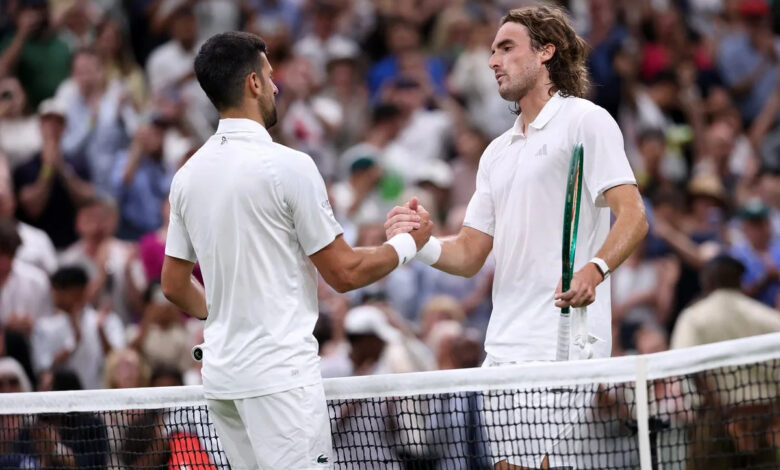

In another world, Novak Djokovic should have been in the heat of battle as he faced the world No 3 Stefanos Tsitsipas at Wimbledon, in a match-up that had previously been staged in two grand slam finals. Instead, it was telling of the relaxed, flowing mood Djokovic was in that he spotted an opportunity to prank an unsuspecting court assistant, who had been asked to help him snip the tape around his shoulder. As she got to work with the scissors, Djokovic suddenly leapt from his seat, pretending he had been given a sharp nip on the arm. It almost gave her a heart attack, before she realised Djokovic was joking. “I was just having some fun,” he said.
No wonder he was in a good mood. This was vintage from Djokovic, as pure and as clean as any of his previous 103 victories at the All England Club, a masterclass of a 6-3 6-4 6-2 victory he raced to in just one hour and 38 minutes. But as the 39-year-old laughed and messed around on Centre Court, the contrast on the other side of the net was clear and Tsitsipas was left to look a sad shadow of his former self. This has never been a good match-up for the Greek; his one-handed backhand is especially vulnerable against the accuracy of Djokovic’s pinpoint serve and return. Having lost his previous 11 matches against Djokovic, this was a demolition.

The last time Tsitsipas had stepped onto Centre Court was 2023, when he returned from an overnight suspension to defeat Andy Murray, in what would turn out to be the two-time champion’s final singles match at Wimbledon. At 24 years old and ranked fifth in the world, having reached his second grand slam at the Australian Open earlier that season, the glow of the talent and potential that radiated from him then has long since diminished. Three years later, Tsitsipas returned to Centre Court ranked 87th in the world. He has now gone nine grand slams without advancing past the second round.
While the sport has moved on, Tsitsipas has been left with the realisation that he must start again. Before Wimbledon, he confirmed, once again, that his father Apostolos Tsitsipas would no longer be working as his coach, insisting that, this time, his decision was final. It was recognition that something, somewhere had gone drastically wrong, and not just because of the back injury that almost forced him to retire from the sport last year. The painful reality is that the gap between himself and Djokovic has grown significantly, all while the 24-time grand slam champion has crept closer to his 40s.
“I could see it, I could feel it,” Tsitsipas admitted.
While Djokovic shrugged: “Stefanos is not in the best shape like he was when he was top 5 in the world and playing grand slam final. That’s obvious. You could feel that in important moments where he would miss some shots that normally maybe he wouldn’t. But that’s tennis.”
Once tipped as a future grand slam champion, his post-match press conference took place in a small room around the corner from Wimbledon’s vast media theatre and was sparsely attended. Wherever Tsitsipas looked was a reminder that whatever star power he once possessed had faded. “I wouldn’t be playing if I didn’t think so. I would have stopped yesterday,” he replied when asked if he believed if he could get back to the point of appearing in a grand slam final. It was just unfortunate that Djokovic had demonstrated to everyone else how far away that dream is from coming true.
From Djokovic’s perspective, he could not have asked for a more routine second-round victory and a more forgiving opponent. He had been pushed in a “very challenging” first-round win over Yibing Wu on Monday and it was clear that Djokovic was not pleased by how deep he had to dig so early in the tournament. By beating Tsitsipas so handily, he has saved himself important energy for his third round match with 25th seed Arthur Rinderknech, the fortnight ahead and a golden opportunity of winning a record 25th grand slam title.

Two games in particular summed it up. The first came as Djokovic broke Tsitsipas for the first time in the opening set. On break point, he dropped deep behind the baseline and returned a series of overheads from the Greek, before springing across the court to launch into an angled forehand, turning defence into attack. The second was when Djokovic closed in on victory and a joke of a return game to secure a 5-2 lead in the third, where every point was worthy of belonging in a highlight reel. “One of the best return games I’ve played in a while,” Djokovic said.
He toyed with Tsitsipas. “I like the terminology ‘vintage’, it is nice because it brings back the best days. Obviously you feel very happy, satisfied and joyful on the court when you are playing this way,” Djokovic reflected.
For Tsitsipas, without his father as his coach, the hope is that he can begin to look ahead. Even at his lowest point, it felt admirable that he retained a positive outlook. “It’s actually the opposite, I’m very relieved for the decision that I made,” he maintained. “I have a tunnel vision, looking way ahead for big things, and I’m enjoying the peace of mind and the responsibility that comes with it. It’s something that I haven’t really dealt with before as much. I think it’s really good for me.”