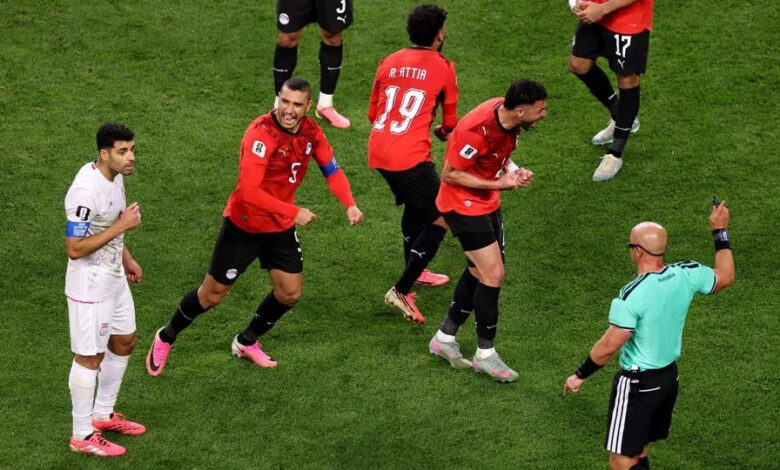

SEATTLE, WASHINGTON – JUNE 26: Egypt players react as referee Szymon Marciniak calls an offside violation and overturns the goal by Shoja Khalilzadeh #4 of IR Iran during the FIFA World Cup 2026 Group G match between Egypt and IR Iran at Seattle Stadium on June 26, 2026 in Seattle, Washington. (Photo by Stu Forster/Getty Images)
Getty Images
You can blame the travel restrictions and other adversity that the U.S. government placed on Iran during a World Cup that coincided with armed conflict between the two nations.
You can blame Austria and Algeria for taking an extremely unexpected route to an expected draw that sent both teams through to the last 32 at Iran’s expense.
But the biggest single culprit in Iran’s failure to advance to the knockout phase is a weird idiosyncracy to the offside law that has long outlived its usefulness.
A Winner That Wasn’t
In case you missed it, Iran briefly believed they had won their Group G finale and sealed their last 32 spot with a second-place finish when Shoja Khalilzadeh slammed a loose ball into the back of the Egyptian net during a goal mouth scramble.
It took minutes before match officials – with the help of semi-automated offside technology – sorted out that Khalilzadeh had been offside on the play by less than the length of his foot.
But the reason Khalilzadeh was offside was because of a technicality in how the law is written, confusing many real-time observers and, during the run of play at least, possibly Khalilzadeh himself.
Here is how the text of the offside law defines an offside position:
A player is in an offside position if:
Any part of the head, body or feet is in the opponents’ half (excluding the halfway line), and …
Any part of the head, body or feet is nearer to the opponents’ goal line than both the ball and the second-last opponent.
In this particular case, Khalilzadeh was ruled offside because goalkeeper Mostafa Shobeir had come to punch clear a ball into the penalty area and failed. And in the process, he moved off his line far enough that he accounted for neither of the last two defenders.
As a result, when Khalilzadeh received te ball, he was technically behind the second-to-last defender, even though you can tell watching replays that he was using the deepest non-goalkeeper as his reference point for staying inside.
Is This Really The Point?
The essential purpose off the offside law is to prevent attackers from what kids on the playground would call “cherrypicking,” standing deep in the opponents’ end to be ready when their team wins the ball back and can play a long pass.
But in the modern game, where goalkeepers are very clearly differentiated from field players, asking attackers to account for goalkeepers when managing their onside status is neither in line with the law’s intention nor realistic.
Goalkeepers are required to wear different colors from field players, making them more difficult to account for even if an opposition player is trying. They are of course allowed to use their hands when trying to play the ball. Unofficially, they are often afforded extra protection by match officials, particularly while inside their penalty areas.
And most to the point, on no level is it common for goalkeepers to venture forward beyond any attacking player, no matter how advanced that attacking player may be. Even sweeper keepers typically stand at the edge of their penalty areas or just beyond, during circumstances when their back line might be tethered near midfield and the ball is in the opponents’ half.
When a goalkeeper has played himself into a position where he is no longer among the last two defenders, the cause is typically a sudden, reactionary play on the ball. If an offensive player finds himself in an offside position following such a play, it is usually because the goalkeeper misplayed the sequence.
In such scenarios, placing the burden of awareness of the goalkeeper’s position on the attacking player as it relates to remaining onside is unrealistic and unfair.
An Easy Fix
The most frustrating part is that, while this is a rarely occurring situation, it is far easier to fix than other conversations legalities that continue to plague the game.
Questions over what makes a penalizable handball, when to play the advantage law, and whether using machines to decide a law written with human eyes in mind all have far more gray area than a potential rewrite to the offside law that would exonerate Khalilzadeh.
The simplest fix is for IFAB to simply re-write the law to stipulate a single last defender, while differentiating a goalkeeper from a defender. Other ideas posed include wiping out offside calls entirely once a team has gained the penalty area, a change that would make the law kind of similar to offside decisions in ice hockey.
Regardless, this much is clear:
By the letter of the law, Khalilzadeh was offside. By its spirit, he and his Iran teammates got a raw deal and don’t deserve to be one of the 16 teams heading home early.
This article was originally published on Forbes.com