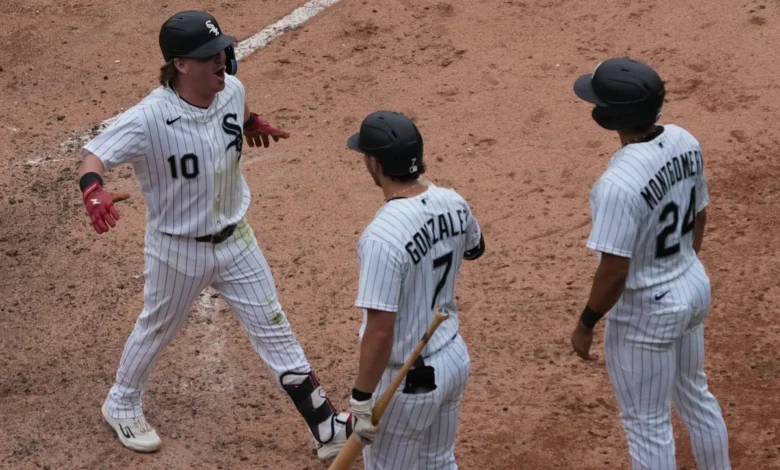

If this week’s homestand was a test of how the White Sox would do against baseball’s best, it’s safe to say they passed.
Thursday’s rainout kept them from a chance at sweeping the Braves, but at the very least they took both series this week, besting Atlanta and the Dodgers, the two teams with the best records in baseball. If the White Sox are showing anything about themselves at 70 games into the season, it’s that they are the real thing.
“I think you should stop thinking of us as a surprise just because we are consistently winning, consistently in every game,” Colson Montgomery said. “It doesn’t matter what team it is, we are not going to overlook them. We are going to play our ball.
“I think yeah, those days are kind of over.”
The White Sox are having so much success this season because of a number of things, but most significantly with an offense that’s taken a big step forward from 2025 and a pitching staff that has leaned into having flexibility about their roles.
Both of these things were on display during the homestand. Braden Montgomery kicked off the week with a tenth inning walk off home run on the day he was called up to the majors, just one of several timely hits the Sox had in the past two series. They scored at least six runs in three of their four wins this week. That’s a product of an offense that doesn’t look the same as it did a season ago.
Headed into Sunday’s game, the Sox offense ranked 11th in baseball in runs scored, which is a major jump from 2025, when they finished the season 27th. The addition of Munetaka Murakami and the new guys coming up and producing has helped, but the top-to-bottom improvement in the lineup is also a product of a philosophical shift driven in part by new hitting coach Derek Shomon.
“We absolutely prioritize swing decisions in our hitting philosophy here at the major league level,” Shomon said. “We talk about it often, but I like to think we do it in a way that also gives some freedom to guys, doesn’t lock them up. It’s not ‘Don’t chase,’ it’s not ‘just make contact,’ right? It is get off on pitches that you feel you can drive. If that comes with some whiff, then so be it. As I said the other day, such is the game of baseball. It’s going to happen. We want our intent to influence our swing decisions.”
As a part of that, the group has embraced trying to be on attack in every inning even through the frames when runs aren’t scoring. A small example of that can be seen in Tristan Peters’ ninth inning home run on Saturday after Dodgers starter Yoshinobu Yamamoto kept them hitless for eight innings.
And then on Sunday, the Sox offense was on a similar course, struggling to get baserunners through the first five innings until the floodgates opened in the sixth. Sam Antonacci led off with a solo homer that tied the game, and five more hits and two more home runs later, the Sox had a six-run inning that proved to be enough to beat the Dodgers to secure a series win.
Miguel Vargas singled and stole second ahead of an Andrew Benintendi double that drove him home, and then Colson Montgomery homered, and finally Braden Montgomery singled ahead of Chase Meidroth’s opposite field home run that capped off the sixth inning Sox runs.
“I think we’ve done a great job all year of just never giving in,” Meidroth said. “It’s one through nine, it’s for nine innings. We’re going to come at you every single day. If we’re getting no-hit through the first five, then we’re going to bring the sticks in the last four. It’s not about which inning you do it in, it’s all about just playing all nine.”

On the other side of all the runs scored in the sixth was the collective work of the pitching staff to hold the Dodgers offense at bay. Manager Will Venable used two openers — Bryan Hudson and Sean Newcomb — before going to Erick Fedde. This left just the last three innings for Grant Taylor and Seranthony Dominguez to cover, and navigating a game this way is possible because of the willingness of the group to accept pitching in different roles from their usual.
“It’s something we’ve got to feed off each other,” Fedde said. “If everybody has that same attitude that makes it a lot easier. Nobody’s been grumpy about it. Nobody’s thrown a fit. That can be poison. But instead we’re being really positive and making the best out of our spots and the opportunities we get.”
Getting guys to do that, to step outside of their normal role, isn’t necessarily something that’s coachable. Some will go along, and some won’t. The White Sox have had success on this front in part because they have identified the right people for these roles, and because the demeanor of the team as a whole is one that leans into that necessary flexibility.
“It’s the culture,” Davis Martin told CHGO. “For a long time we didn’t know what the culture was, and I think last year we finally solidified that as, ‘Hey, when your name is called, go out there, be yourself, have fun, play the game to the best of your ability. I think everybody is starting to realize this is where we slot in.”
The next test ahead of the Sox is getting more wins on the road. Games at The Rate have been especially friendly this year; the Sox are 24-12 at home compared to 14-20 in away games. The upcoming road trip won’t be an easy one, either. The Sox head to the Bronx first to face the first-place Yankees, and then they go to Detroit for three important divisional games.
But the Sox will head out with a confidence-boosting homestand behind them, and for as much as they emphasize not treating any series differently from another, there is something to having beaten the Braves and Dodgers.
“In spring training, we looked around [and] we thought this is a team that has a lot of talent, a lot of skill. Obviously going out there and proving it is a completely different thing,” Fedde said. “But I guess the guys in here aren’t shocked and the way we’ve been playing, like I said on this stretch of quality teams and opponents, we’re putting the league a little bit more on notice.”